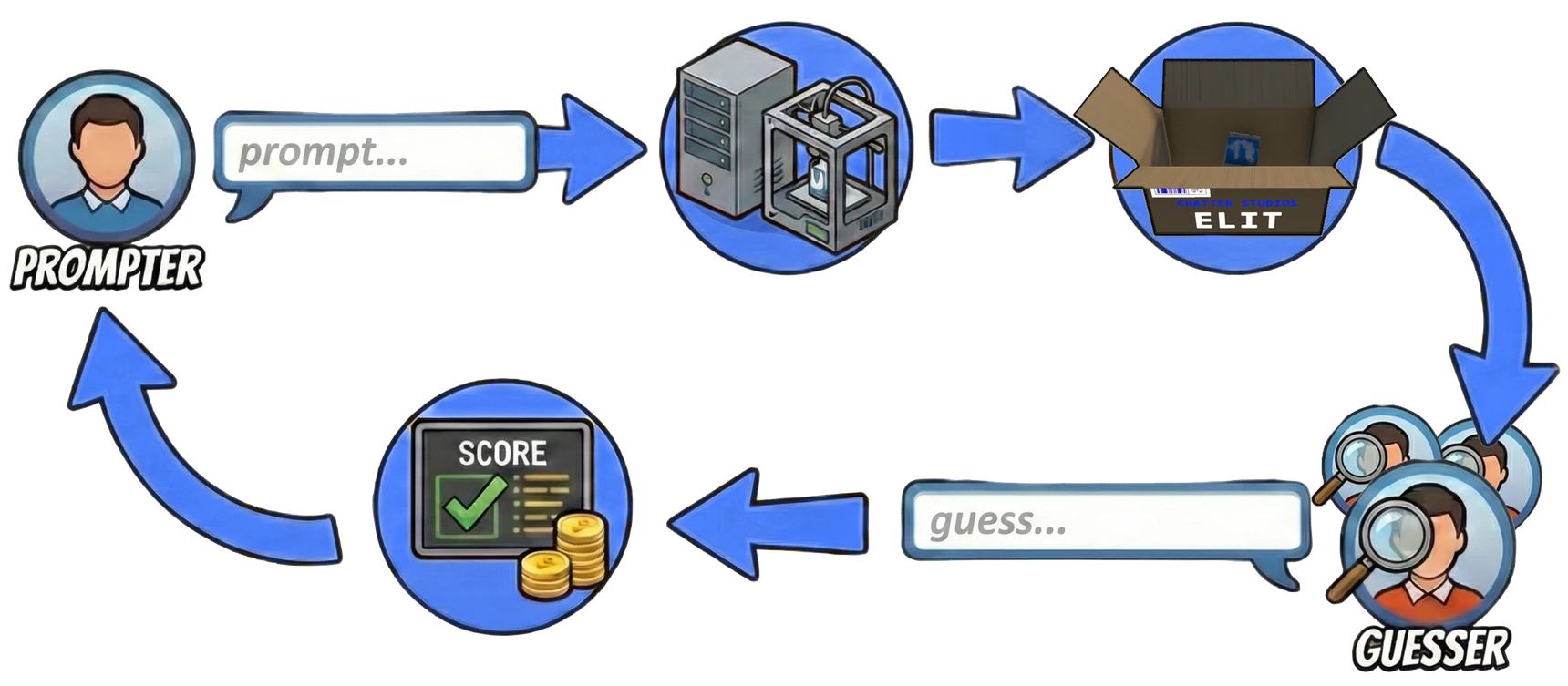
ELIT combines text prompting, 3D object generation, and guessing a hidden concept into a fun, fast-paced multiplayer game.
Core Game Loop
Each round has one Prompter and multiple Guessers. The Prompter describes a hidden concept without
prompting it directly, the AI generates a 3D object, and the object is packed and thrown into
the arena. The Guessers then race to identify the concept and score points before the round ends.
The Roles
Prompter
You receive a hidden concept and cannot prompt it directly. Instead, you create clues by prompting nearby objects for
the Guessers. After each prompt, two generated objects appear: one is auto-painted, and one can be painted manually.
You choose one, throw it into the arena, and keep building clues until time runs out or everyone guessed correctly.
Guesser
Guessers explore the city, find the prompted clues, and race to identify the hidden concept. You can
slow rivals down with grabbing, throwing, and using power-ups. Each guess costs you points, but you earn points
by guessing correctly. So choose wisely when and what to guess.
Power-Ups
Freeze
Stops enemies briefly and opens a short window to take the lead.
Bomb
Creates knockback chaos and displaces opponents and the target object in tight situations.
Punch Throw
Adds knockback pressure and lets you displace players and objects from key positions.
Point System
Prompters earn more points when Guessers identify the concept quickly, so clear prompts are rewarded.
Choosing the AI-painted version of a generated object costs the Prompter points. Guessers lose points for each guess attempt, but faster correct guesses earn more.
This creates a constant trade-off between guessing early for maximum points and waiting for more clues to avoid penalties.
Prompter Scoring
Faster correct guesses by the team increase the Prompter's reward.
Guesser Scoring
Each guess costs points, but faster correct guesses earn more.
Risk vs Reward
AI-painting and guessing costs points, but helps finding the concept.
Tamed Growth
With each prompt and generation, object quality decays on purpose: models drift away from the target
concept and pick up surface noise. At the same time, score affects player balance: more points
make you larger and slower, while fewer points make you smaller and faster. This tames leading
players while helping trailing players grow back into the match. That is our interpretation of tamed growth.
Smart Feedback
We use word embeddings to compare the target concept with each player guess. A glow effect visualizes semantic
distance in real time: green means close or correct, while orange to red indicates weaker
guesses.
Technology
We use Steam for multiplayer, so joining friends is as easy as using your friends
list. We also added proximity chat, allowing players to communicate directly in-game. In the background,
a university-hosted server runs our 3D object generation pipeline. Prompts are sent to that server and
returned as usable in-game objects. The same technology also supports character creation, letting
players build highly customized avatars and create even more fun multiplayer moments.